My clock alarm used to ring at 5:30 am every weekday. My kitchen woke up with me because it was time for cooking. No, I did not have a food business. I just had a mom business. Each school day, I prepared lunch for my kids. They are very selective about food. Rice, eggs, tomatoes, chicken breast, and others were freshly cooked or prepared. It was never a burden for me to do this each morning; I did it with joy and love every time. My two older kids are autistic; therefore, is hard to think about their future and the fact that mommy will not be forever with them preparing their meals. I kept asking myself how they could begin to like other dishes beside mine, and I came up with a brilliant idea: School lunch is a good place to experiment with new kinds of foods. This year, my older son, who is less selective than the other one, is being part of “the experiment”. I hope this idea works; after all, the schools know what the students need better. They have specialized people working to make the School Nutrition Program better every day; at least, it is what they say.
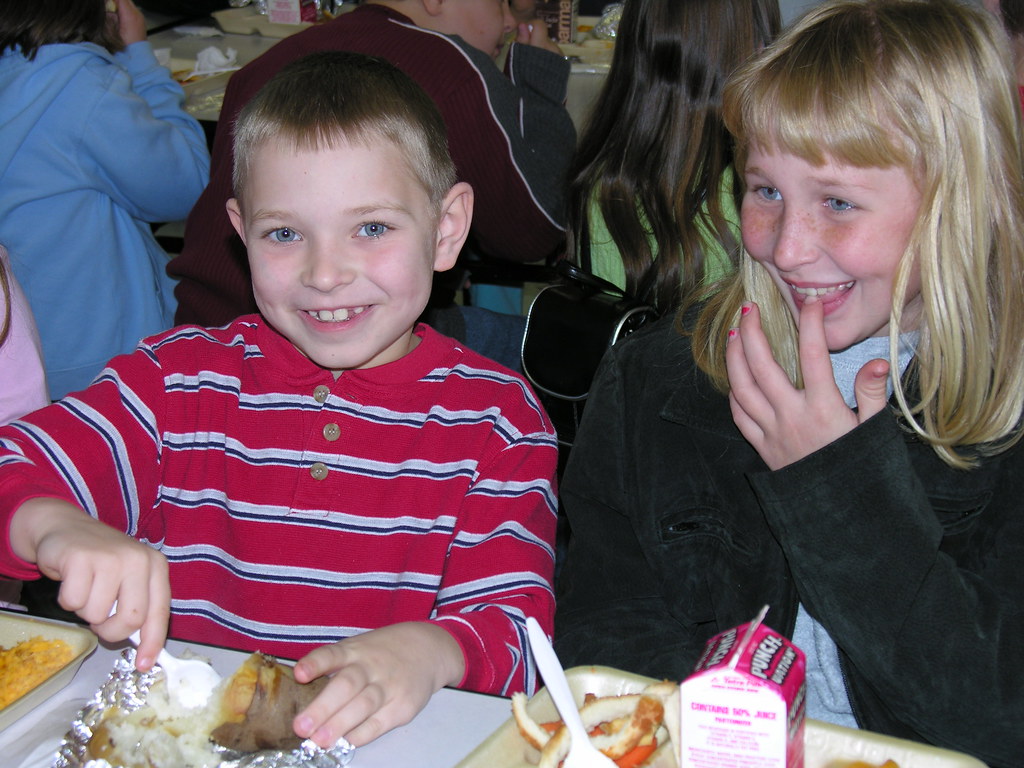 As a caring mother, I had to go and check for myself how my experiment was going. I remember my first time at the school cafeteria when I joined my children at lunch. The front wall had a big painting with intense colors that showed a jungle with all kinds of wild animals. A smile was on my face. I did not know whether it was painted just because kids love animals or because of another hidden reason. I thought it could be the last one because that room was the closest thing to a jungle I ever saw (in a good way). Every person there was different in age range, size, and color of skin. I got a very good impression of the environment. Everything looked clean and messy at the same time, but it was a good mess. Students and teachers shared this moment with joy; they were just relaxed. It was certainly a place to share food, jokes, and opinions. They were speaking, laughing and, of course, eating altogether. The cafeteria staff was very busy filling the lines with food, attending students’ payments, and cleaning some chaotic tables. I was so enthusiastic about spending this time with my kids that I forgot to eat.
 “Is it always that busy?” I asked an employee, who was cleaning some juice spilled on the floor. “Oh, yes, mam, it is. And sometimes, it gets worst.” And then she laughed while returning to the kitchen. Every person in that room seemed to enjoy the moment, even the cafeteria workers. My eyes kept looking around, and finally, I saw something interesting. A poster near the door written in colored letters read: “Healthy Meals Served Here!” I looked at my plate inspecting carefully my lunch, and I could almost hear Michel Pollan, an award-winning author, saying: “Don’t eat anything your great grandmother wouldn’t recognize as food” (10). I looked over the other plates, but I couldn’t identify anything. Is that what they mean by healthy food? I never could say what were Mozzarella Sticks, Pepperoni Fun Lunch or Steak Nuggets & Roll. I do not know if it is because I am not from America, and I did not grow up here that I struggled to identify these food’s names.
I came to school another day at breakfast time. On that occasion, my interests were different; I was looking for some answers. I approached the Principal to tell her that I was writing about the school cafeteria, and I would like to know more about the food they serve there, as well as the nutrition program of the school. “There is a monthly schedule of our meals where you can find everything about the food we serve here;” she said very politely “also, on our website you can read about the nutrition program” (Smith). Maybe because it was not a good time to ask, I got a quick answer that was not what I was looking for. Later at home, I examined the schedule carefully. A lot of interesting things, I could find. Thirty-four entrees, twelve different fruits, and twenty-five vegetable-based dishes made up the schedule for three weeks; after that, the cycle of meals began again. The beats of my heart increased while I was writing the list. I had wanted to have all this food in my elementary school cafeteria in Cuba. Even though I had not a lot of variety and quantity of food, the meals I ate at my school cafeteria were prepared with fresh and organic ingredients. America is amazing; it is a nation with uncountable resources to be exploited. I am blessed to be here. I am also thankful because my kids have lunch for only 0.40 cents; however, in my opinion, this country has enough provisions to feed its children with real healthy food, and not with “foodish products” (Pollan 11). The school meals it has variety, for sure, but lacks quality in terms of natural food.
“Let’s Eat Healthy!” announced the monthly schedule on the back of the paper, but when I read it, I could only see meals made with highly processed ingredients and non-seasonal or fresh vegetables and fruits. Finally, I visited the school website which sent me to another website that showed this information: “School Nutrition employees follow menus and prepare meals according to standardized recipes to ensure that students receive meals that meet current USDA menu planning guidelines” (Walton). Maybe I did not understand properly; however, what I concluded about this statement is that a hotdog (which is a popular entrée among students) is qualified as a healthy food because the nutrition authorities say so. Well, I feel lost, because I had always heard that hotdogs are junk food.
“October is National Farm to School Month”. It is another announcement on the monthly schedule that got my attention. That phrase reminded me of an article by Troy Johnson, who is well-known for his program Crave on the Food Network and his work as a dining critic, titled Farm to Fable. He uses some stories as examples of the big fraud that many restaurants are doing while using the Farm-to-table concept without putting into practice. “Like any good movement, Farm to table has now been co-opted.” state Johnson, “The stories of restaurants deceiving their customers – or flat out lying to them – have increased” (191). I felt identified with the last sentence because it has a similarity with the school when they tell the parents about serving healthy food to the students, and clearly, they do not. The school meals are highly processed. The food providers are too far away to be local farmers, because the food that arrives at school kitchens came pre-cooked, and people can’t find pre-cooked food in nature. Although they claim to meet the USDA regulations, most industrial food is not healthy enough to feed our kids.
 We can find in classic literature as in Little House on the Prairie or Anne of Green Gables, how was back in the 19th century when rural students went home during lunch break and ate fresh homemade meals. The image of kids bringing to school apples for their teacher and their snacks, makes me feel nostalgic for moments that I would want to be part of my childhood. Why did things have to change? An article from Time written by Emmerly Rude, a food historian and the author of Tastes Like Chicken, writes a bit about school lunches history. “By 1900, 34 of the then 45 states had laws calling for compulsory education of all children under the age of 14… reformers saw the need to improve the outcomes of all students drawn into the education system… Philadelphia and Boston were the first two American cities to institute school lunch programs,… serving up hot meals for the price of a penny in high schools as early as 1894”(Rude). The first problem was solved. However, another issue came out to light: The use of cheap food at schools compromised the student’s health. “No Such Thing as a Free Lunch” is the title of another article, which was written by Dr. Teja Pristavec a sociologist and a postdoctoral research associate at the University of Virginia Biocomplexity Institute and Initiative. In her article, she explores the idea of the evident cost of free meals at schools. She suggests that the government solution of resolving the money issue is affecting kids’ health (Privastec). I think she is not far from the truth; the increase of diseases as diabetes and obesity in America maybe has its cause in school lunches quality.
I felt like my brain was going to explode. The proverb says that the road to hell is paved with good intentions, and this saying fits perfectly in my reasoning about how wise could be the decision to let our children eat the school cafeteria food. Well, we cannot blame those people who advocate for our kid’s rights and are always finding a better way for everything; they also have the best of the intentions. But neither we can’t leave our responsibility in others’ hands. We need to do our best to find the issues, communicate them, organize them in terms of significance and try to fix them in that order. They are our children after all, and we need to decide what matters, and what are our priorities. I will state my determination going back to the days when I prepared my son’s school lunch, and when somebody asks me why I do that, then I could explain my good reasons; who knows if I can help other parents to open their eyes and question their priorities as I did once.
"Apple, Carrot, and Celery Juice 1of2" by Food Thinkers is licensed under CC BY-NC-SA 2.0
"Boy and Girl Enjoy Lunch" by Old Shoe Woman is licensed under CC BY-NC-ND 2.0
"KTA Lunch Lady illustration" by Alexis Moulds is licensed under CC BY-NC-ND 4.0
WORKS CITED
Johnson, Troy. “Farm to Fable”. Food Matters, edited by Bauer, Holly Bauer. Bedford/St. Martin’s, 2017, pp. 191-195.
Pollan, Michael. “Eat Food: Food Defined”. Food Matters, edited by Bauer, Holly Bauer. Bedford/St. Martin’s, 2017, pp. 10-19.
Pristavec, Teja. “No Such Thing as a Free Lunch: Part I”. The Society Pages, 14 May 2014, thesocietypages.org/socimages/2014/05/14/no-such-thing-as-a-free-lunch-part-i/.
Rude, Emmerly. “An Abbreviated History of School Lunch in America.” Time, Sept. 2016, time.com/4496771/school-lunch-history/
Smith, Sarah. Personal interview. 26 Sept. 2019.
Walton County Public District. Walton County Public District: School Nutrition, Accessed Sept. 2019, www.walton.k12.ga.us/SchoolNutrition.


